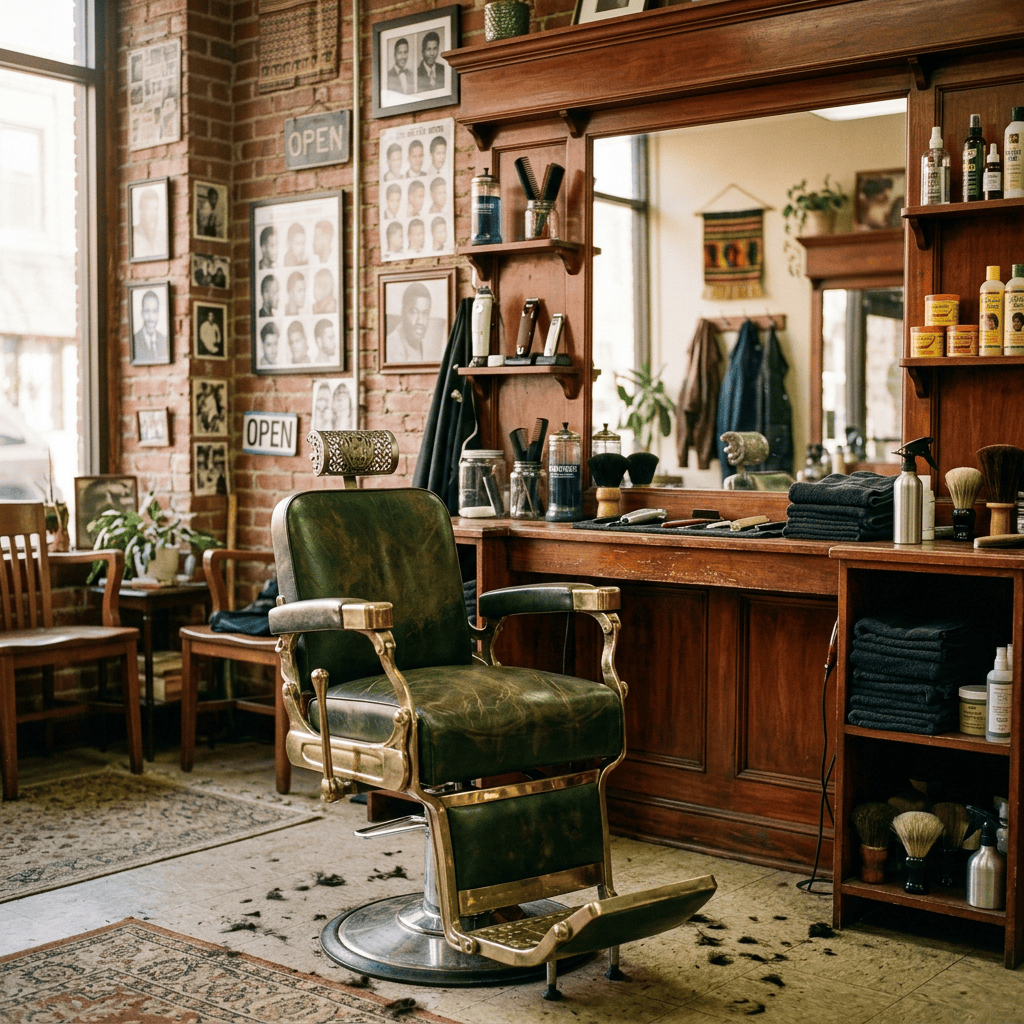
There is something remarkable about the barber’s chair.
A man can spend months avoiding difficult conversations with friends, family members, colleagues, and even himself, yet place him in a barber’s chair for forty-five minutes and suddenly conversations emerge that would never appear elsewhere.
Discussions about relationships
Financial struggles
Career frustrations
Mental health
Fatherhood
Dreams
Failures
Regrets
Many barbers will tell you that they have become part stylist, part mentor, part counsellor, and part confidant.
The question is: Why?
What is it about the barber’s chair that encourages men to speak so openly?
The answer reveals something important about human connection and, perhaps, something profound about modern society.
The Safe Space Without Pressure
One reason is that the barbershop occupies a unique position between friendship and professionalism;
The barber is not a spouse
Not a parent
Not a manager
Not a child
Not someone who is likely to be directly affected by the client’s decisions, which creates a psychologically safe environment. Men often feel less judged because the conversation exists outside their normal social circles, therefore there is little pressure to maintain a particular image.
The barber knows enough about your life to understand your circumstances but usually not enough to become entangled in its complexities.
This balance creates trust.
Side-by-Side Communication
Psychologists have long observed that many men are often more comfortable communicating side-by-side rather than face-to-face, men frequently have important conversations while:
Walking
Driving
Playing sport
Fishing
Working
Exercising
The barber’s chair mirrors this dynamic.
The conversation is rarely an intense face-to-face interaction, instead, both people focus on the haircut while talking so the attention is shared and eye contact is reduced so the pressure associated with vulnerability often decreases.
For many men, talking becomes easier because the conversation itself is not the primary focus.
Ritual Creates Openness
The barbershop is more than a business as for many communities, particularly within African, Afro-Caribbean, and African American cultures, it is a social institution.
Historically, barbershops have functioned as places where men gather, exchange ideas, debate current events, build relationships, and support one another. The haircut itself becomes a ritual and;
Rituals create predictability
Predictability creates comfort
Comfort creates openness
When a man has visited the same barber for years, trust develops naturally.
The haircut becomes secondary
The relationship becomes primary
The Power of Being Heard
One of the most undervalued human needs is the need to be heard.
Many people assume advice is what others need most but this is often not the case. Often they simply need someone who listens without interruption.
Without judgement and without immediately trying to fix them.
A good barber understands this instinctively
The best barbers know when to talk and when to listen
They understand that sometimes a customer is not looking for answers but rather are looking for understanding
In a world increasingly dominated by digital communication, the simple act of being present with another human being has become surprisingly powerful.
The Barber as Community Elder
Across many African societies, wisdom was traditionally shared through communal spaces;
Stories were exchanged
Lessons were passed down
Problems were discussed collectively
Guidance came from elders, respected community members, and trusted peers. In many ways, the modern barbershop continues this tradition.
The barber often occupies a unique role within the community as
he hears stories from multiple generations and understands local challenges.
He witnesses people succeed, struggle, marry, divorce, become parents, lose jobs, build businesses, and rebuild their lives.
Without formal qualifications, many barbers become repositories of social knowledge and they observe life unfolding from one haircut to the next.
What the Barber’s Chair Teaches Us
The popularity of barbershop conversations reveals an important truth.
People do not merely need solutions, they need connection.
Modern society often focuses on efficiency;
More technology
More productivity
More speed
Yet the barber’s chair reminds us that human wellbeing is also built upon something much simpler:
Conversation
Presence
Listening
Belonging
Trust
The fact that so many men open up in barbershops suggests that many are carrying far more than they reveal publicly. It also suggests that opportunities for meaningful conversation may be rarer than we think.
From an Afroglobal perspective, the barber’s chair represents something larger than a haircut, it represents community, it reflects an ancient understanding that human beings are not designed to carry every burden alone. Across Africa and throughout the diaspora, communal spaces have always played an important role in emotional wellbeing;
The village square
The family courtyard
The marketplace
The community gathering
The barbershop is, in many ways, a modern continuation of this tradition, being a place where stories are exchanged, wisdom is shared, relationships are maintained and humanity is affirmed.
More Than a Haircut
The next time you walk into a barbershop, look beyond the mirrors and clippers as what appears to be a simple transaction is often something much deeper. The barber’s chair is a place where men remove more than hair.
They often lay down worries, unpack frustrations, explore dreams, process challenges and reconnect with themselves.
Perhaps the enduring lesson of the barber’s chair is this:
People are transformed when they feel safe enough to be honest and
sometimes healing does not begin with therapy, self-help books, or grand life changes. Sometimes it begins with a conversation, a trusted listener and a chair that somehow encourages people to tell the truth.
Fiona Lewis