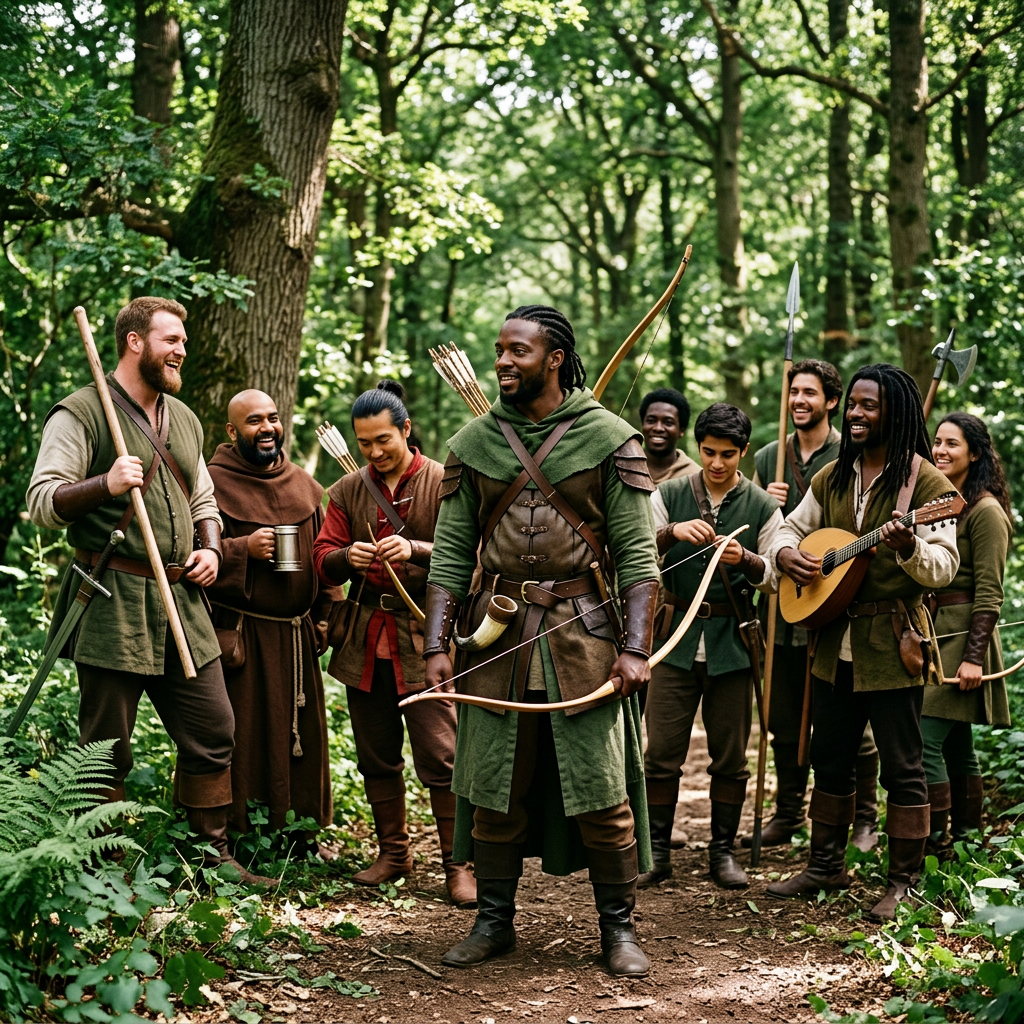
For centuries, the legend of Robin Hood has been woven into the fabric of English folklore: the noble outlaw in Lincoln Green, the master archer of Sherwood Forest, the champion of the poor against corrupt authority. Traditionally, Robin Hood has been imagined as a white English yeoman, a symbol of medieval English identity.
But modern cultural scholarship, identity‑focused reinterpretation, and historical analysis have opened the door to a bold and compelling theory: that Robin Hood and his Merry Men may have had Afroglobal heritage.
This theory does not claim to rewrite established historical fact. Instead, it challenges long‑held assumptions, highlights overlooked evidence, and invites us to reconsider who gets to be a hero in Britain’s foundational myths.
The Origins of the Theory
The idea of an Afroglobal Robin Hood emerges from three interconnected areas of research:
African presence in medieval Britain
Reinterpretation of early outlaw ballads
Evidence of diverse communities in medieval Nottinghamshire and Yorkshire
Together, these strands create a plausible cultural backdrop for a more diverse Robin Hood than the one popularised in Victorian literature.
African Presence in Medieval England
Historical records show that people of African descent lived in Britain long before the earliest Robin Hood ballads appeared.
Roman Britain (1st–4th century)
African soldiers, administrators, and traders served across the Roman Empire. Archaeological finds in York and London confirm the presence of individuals of North and East African ancestry.
Medieval England (5th–15th century)
Documents reference “black” individuals in royal courts, ports, and market towns. Some were free citizens, some were sailors, and others were craftsmen or labourers.
The Crusades (11th–13th century)
Returning soldiers, merchants, and travellers brought African influences back to England, including alliances, friendships, and mixed‑heritage families.
This evidence establishes a simple truth: medieval England was not ethnically homogenous, and Sherwood Forest was not isolated from global movement.
Clues in the Outlaw Ballads
The earliest Robin Hood ballads (14th–15th century) describe him as:
“of unknown birth”
“outside the law”
“dark of hue”
“a man apart from the common folk”
The phrase “dark of hue” appears in multiple versions. While often dismissed as poetic language, medieval texts frequently used this phrase to describe complexion.
Additionally:
Robin Hood is repeatedly described as foreign‑looking, unusual, or distinct from local yeomen. His Merry Men, especially Little John and Much the Miller’s Son, are portrayed as outsiders, not typical English peasants. These descriptions do not prove Afroglobal heritage, but they open interpretive space for a more diverse understanding of the legend.
Sherwood Forest as a Refuge for the Marginalised
Historically, Sherwood Forest was a sanctuary for:
displaced people
foreigners
escaped servants
soldiers returning from foreign campaigns
individuals fleeing feudal oppression
If Afroglobal individuals lived in medieval England and evidence shows they did, Sherwood Forest would have been a natural refuge. This aligns with the Merry Men’s portrayal as a multi‑background brotherhood united by resistance rather than lineage.
The Greenwood as a Symbol of Cultural Resistance
Robin Hood’s story is fundamentally about:
resisting oppressive systems
redistributing wealth
protecting the vulnerable
challenging corrupt authority
These themes resonate strongly with Afroglobal histories of resistance, liberation, and community solidarity. The theory suggests that Robin Hood’s legend may have been shaped consciously or unconsciously by stories of African or Afro‑diasporic figures who resisted injustice across medieval trade routes and cultural exchanges.
Evidence Supporting the Afroglobal Interpretation
A. Descriptions of complexion
The “dark of hue” references are the strongest textual clues.
B. African communities in medieval Yorkshire and Nottinghamshire
Trade routes brought African sailors and merchants to northern England.
C. Multicultural outlaw bands
Historical outlaw groups were often ethnically mixed, reflecting the diversity of medieval England.
D. Victorian erasure
Victorian writers intentionally “English‑washed” medieval stories to fit nationalist narratives, often removing non‑white characters from historical reinterpretations.
E. Oral traditions
Some Afro‑Caribbean and African communities have long adapted Robin Hood as a symbol of resistance, suggesting cultural resonance beyond England.
Why This Theory Matters
It expands British identity as recognising diversity in medieval Britain challenges the myth of an exclusively white past.
It empowers Afroglobal communities, as seeing themselves reflected in foundational British legends strengthens cultural belonging and identity.
It corrects historical erasure as many non‑white figures were removed from historical narratives by later writers. It enriches the Robin Hood story,
as a multicultural Robin Hood aligns more closely with themes of justice, solidarity, and resistance and it supports inclusive education, as for children, this interpretation opens doors to pride, representation, and historical curiosity.
Reclaiming the Legend
The theory that Robin Hood and his Merry Men may have had Afroglobal heritage is not a definitive historical claim. It is a cultural reinterpretation grounded in evidence, historical gaps, and the lived diversity of medieval England.
It invites us to imagine a Robin Hood who represents all of Britain’s people, past and present. A hero whose story belongs not only to the greenwood, but to the global tapestry of resistance, identity, and hope.
By Michael Frazer