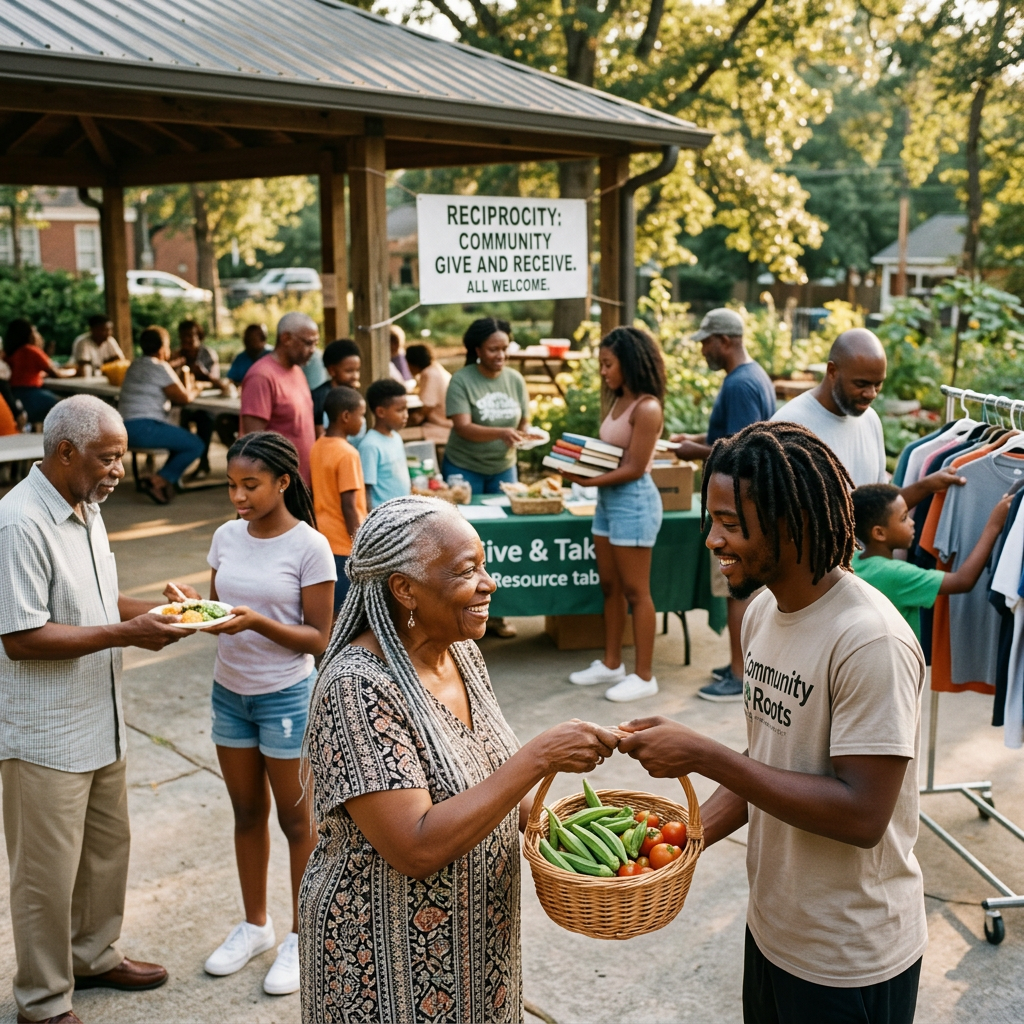
The deepest truth about reciprocity is simple: what you give, freely and joyfully, without calculation, has a way of circling back to you in forms more abundant than you imagined. But this principle is often misunderstood. It is not a vending machine where you insert kindness and expect a guaranteed payout. It is a science‑supported, spiritually rooted, culturally affirmed way of being that transforms both giver and receiver.
The Science and Spirit of Reciprocity:
The most powerful returns in life, financial, emotional and relational, flow to those who give with a cheerful heart and no expectations. Science, psychology, and Afroglobal cultural wisdom all affirm this.
The Principle: Giving Creates a Return Flow
Across cultures, religions, and philosophies, one truth repeats: life responds to generosity.
- In Christianity: “Give, and it shall be given unto you.”
- In Islam: charity (sadaqah) multiplies blessings.
- In African philosophy: Ubuntu,“I am because we are.”
- In behavioral science: generosity increases well‑being, trust, and social capital.
But the quality of giving matters.
A gift given with expectation is a transaction.
A gift given with joy is an investment in the universe.
This is why the cheerful giver is central to every tradition.
The Science Behind Why Giving Works
Modern research backs what our ancestors already knew.
The Helper’s High
Neuroscientists have found that giving activates the brain’s reward system, releasing dopamine, oxytocin, and endorphins.
This improves, emotional resilience, creativity, problem‑solving and ultimately long‑term happiness
These internal shifts make you more magnetic to opportunities.
Social Reciprocity Theory
In sociology and psychology, reciprocity is a foundational principle:
people naturally return kindness with kindness.
Generous people build, stronger networks, deeper trust, more opportunities for collaboration and better reputations.
This is especially true in Afroglobal communities, where communal support systems have historically been survival tools.
The Law of Indirect Return
Research shows that giving rarely returns from the same person you gave to.
Instead, it comes from unexpected directions, new relationships, new opportunities, new blessings. This is why giving to receive often fails and the principle doesn’t respond to manipulation; it responds to intention.
Giving Money: The Circulation of Prosperity
Money is energy. When held tightly, it stagnates. When circulated, it multiplies.
In Afroglobal communities, we see this in:
- susu / esusu / stokvels
- harambee contributions
- family remittances
- community fundraising
These systems work because they are built on trust, joy, and shared uplift. When you give money cheerfully:
- you affirm abundance
- you reduce fear
- you strengthen your community
- you open channels for unexpected financial return
But when you give with resentment or expectation, you block the flow.
Giving Love and Care: The Emotional Echo
Love given freely is rarely lost.
Psychologists call this emotional reciprocity, the tendency for affection, kindness, and warmth to be mirrored back. In Afroglobal families and diasporic communities, love is often expressed through, checking in,cooking for others, supporting dreams, sharing wisdom and protecting each other.
These acts create emotional wealth that returns through:
- stronger relationships
- deeper belonging
- mental health benefits
- generational resilience
Why Expectation Blocks the Return
Expectation turns giving into a contract, contracts create pressure, pressure creates resistance and resistance blocks flow.
When you give with expectation:
- your energy shifts from abundance to scarcity
- people feel the weight of your motives
- the reciprocal principle responds to the fear behind the gift, not the gift itself
This is why some people say, “I give so much but get nothing back.” The intention and not the action, determines the return.
The cheerful giver gives because it aligns with their values, it feels good, it uplifts others, it expresses abundance and it is this that returns multiplication.
The Afroglobal Lens: Reciprocity as Cultural Power
Across Africa and the diaspora, reciprocity is not just a principle, it is a survival strategy, a cultural identity, and a spiritual inheritance.
Examples include:
- Ubuntu: “A person is a person through other people.”
- Ujamaa: cooperative economics in Pan‑African philosophy.
- Caribbean community care: neighbors raising each other’s children.
- African‑American mutual aid traditions: churches, sororities, fraternities.
These systems prove that collective giving creates collective rising.
When Afroglobal communities give:
- we preserve culture
- we build generational wealth
- we strengthen global networks
- we rewrite narratives of scarcity into abundance
The Real Secret: Give From Overflow, Not Obligation
The most powerful giving comes from joy, gratitude. abundance, purpose not guilt, pressure or expectation.
When you give from overflow, you activate a cycle:
Give → Grow → Receive → Give again
This is how communities thrive.
This is how individuals prosper.
This is how the reciprocity principle responds.
Reciprocity is not magic, it is alignment.
When your intention is pure, your heart is open, and your giving is joyful, life mirrors that energy back to you in ways you cannot predict.
Money returns as opportunity.
Love returns as connection.
Care returns as community.
Generosity returns as abundance.
The Afroglobal story is living proof:
We rise higher when we lift others.
By Diana Heckman