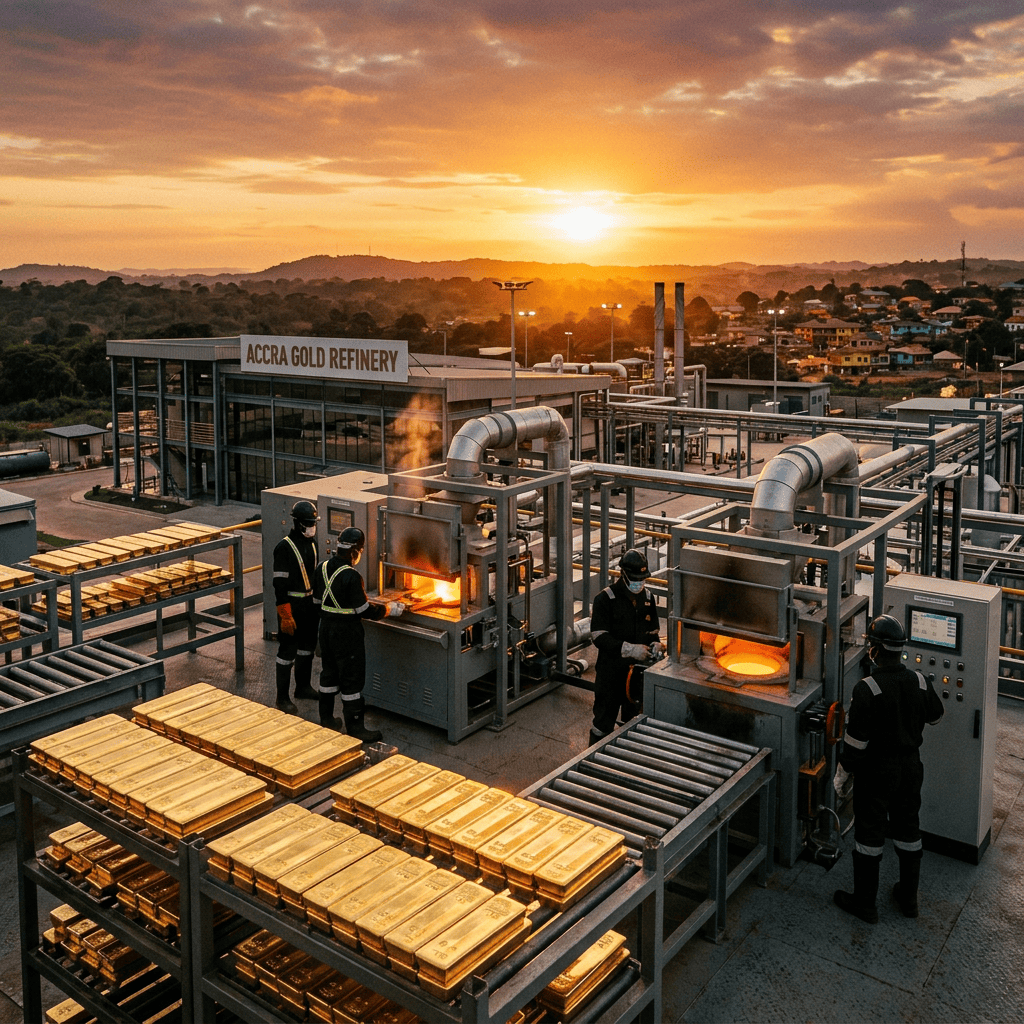
Ghana’s rise as Africa’s largest gold producer and its bold September 2026 decision requiring all gold doré to be refined within Ghana, marks a historic turning point for the continent. It is more than a policy shift; it is a declaration of economic self‑determination, industrial maturity, and Afroglobal confidence.
Ghana’s Refining Mandate: A New Era of Value Retention
Effective 1 September 2026, Ghana’s Gold Board (GoldBod) enforced a rule that no unrefined gold doré can leave the country. Exporters must refine locally or face suspension, licence revocation, or sanctions.
This follows years of Ghana losing billions in refining margins to Switzerland, South Africa, and the UAE.
Now: Ghana produced nearly six million ounces of gold in 2025, earning $20 billion in export revenue. The country has expanded refining capacity to 45 tonnes annually, nearly triple 2024 levels, a new policy requires 30% of large mines’ output to be delivered as doré for local refining, a major shift in the gold value chain. This is not symbolic, it is structural.
What This Means Financially for Ghana
The financial implications are profound:
More Money Stays in Ghana
Refining margins – historically captured offshore, now remain in-country. These margins include:
Assay fees
Processing fees
Value‑addition premiums
All of these now feed Ghanaian jobs, Ghanaian companies, and Ghanaian GDP.
Stronger National Reserves
Ghana aims to grow gold reserves from 19.2 tonnes toward its 2028 target of 157 tonnes, strengthening currency stability and import cover.
Industrialisation Through Mining
Local refining stimulates:
Skilled employment
Technology transfer
Domestic manufacturing of bullion
Growth of local financial instruments backed by refined gold
This is how nations build sovereign wealth.
Reduced Smuggling & Pricing Opacity
By tightening the value chain, Ghana closes loopholes that previously enabled:
Under‑declaration
Informal trading
Loss of tax revenue
What This Means for Africa
Ghana’s move is part of a continental pattern: Africa is refusing to export raw wealth, which is the beginning of a new industrial era.
Africa Is Moving Up the Value Chain
For decades, Africa exported raw minerals and imported finished products at a premium, now, Ghana’s gold refining rule signals a shift toward:
Local beneficiation
Local processing
Local ownership of margins
This is the same logic behind Nigeria’s oil refining revolution.
Nigeria’s Oil Refinery: A Parallel Transformation
Nigeria’s massive refinery infrastructure, including the Dangote Refinery, represents Africa’s determination to stop exporting crude and importing expensive refined fuel and the trend mirrors Ghana’s gold strategy:
Produce locally
Refine locally
Sell globally
Retain value
Both nations are rewriting the rules of engagement with global markets, in fact Africa is rising across multiple sectors:
Critical Minerals Processing
Countries like DRC & Zambia are building battery‑grade cobalt and copper processing and Zimbabwe is restricting raw lithium exports. These policies echo Ghana’s gold stance: Africa will not be a raw‑material warehouse.
Energy Independence
Kenya and Ethiopia expanding geothermal
South Africa scaling solar and green hydrogen
Nigeria and Ghana pushing gas‑to‑power industrialisation
Energy security fuels industrial growth.
Digital & Fintech Expansion
Kenya’s M‑Pesa
Nigeria’s Flutterwave
Ghana’s digital payments ecosystem
These platforms create Afroglobal financial autonomy.
Agriculture & Food Processing
Côte d’Ivoire and Ghana increasing local cocoa processing
Kenya expanding tea and coffee value‑addition
Senegal investing in fisheries processing
Africa is learning that value is created after extraction, not before.
Why This Moment Is Inspirational for the Afroglobal Community
Ghana’s gold refining mandate is more than economics, it is symbolism.
It says:
Africa will define the terms of its wealth.
Africa will refine its own resources.
Africa will rise by its own design.
For the Afroglobal community, this is a call to Invest in African industries, build African‑owned supply chains, support African innovation and celebrate African sovereignty.
This is the Africa our ancestors dreamed of, an Africa that does not apologise for its brilliance, its resources, or its global influence.
The Trend Is Clear: Africa Is Moving Forward
Ghana refining its gold, Nigeria refining its oil, Zimbabwe refining its lithium, Kenya refining its digital economy and Senegal refining its agriculture. This is not coincidence, this is continental alignment.
Africa is stepping into a future where raw wealth becomes refined power, and refined power becomes global influence. Ghana’s September 2026 gold refining mandate is a landmark moment, one that strengthens Ghana financially, elevates Africa industrially, and inspires Afroglobal communities worldwide.
Africa is no longer waiting for permission, it’s building, rising and refining its destiny.
By George Tetteh