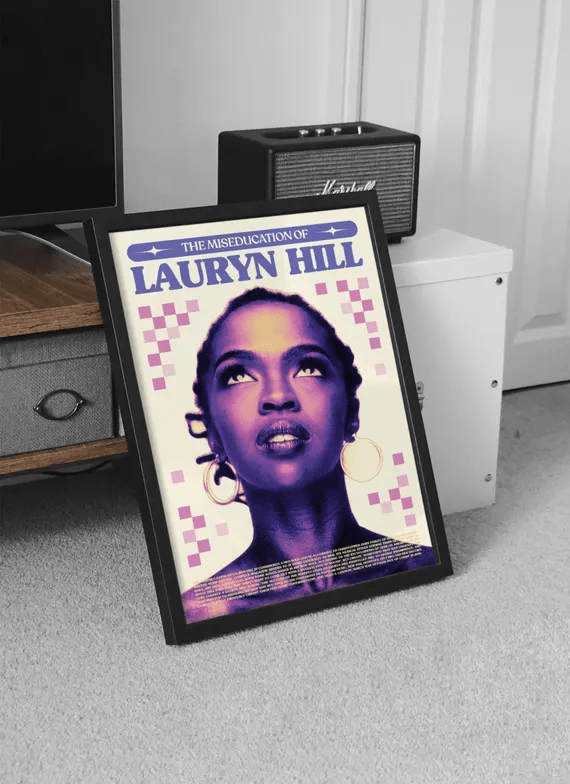
When I was told there would be an article about Lauryn Hill, there was absolutely no way that article wasn’t going to be written by me. Anyone who truly knows me, family or close friends, understands how deeply Lauryn shaped my early world. Growing up, she wasn’t just one of my favourite icons; she was a mirror, a muse, and a spiritual compass.
I remember the era when I wrote poetry endlessly, when my creativity felt like it was spilling out of me faster than I could catch it. It was a period of spiritual awakening, a time when I was learning that life was more than materialism, more than the surface. And then The Miseducation of Lauryn Hill hit the streets, and I was mesmerised.
Tracks like “That Thing” refined Black womanhood for me. Lauryn educated young women on self‑respect, boundaries, and the destructive cycles of disrespect and over‑sexualisation that society often normalised. She held up a mirror to men too, highlighting their role in those cycles. In that era, Lauryn wasn’t just an artist; she was a modern‑day spiritual leader, a healer. And when she sang “Zion”, I felt it in my bones. I connected with it deeply, linking it to my own journey into motherhood.
Her collaborations, like If I Ruled the World with Nas, showed her range, her ability to move between worlds while keeping her core message rooted in evolution, truth, and innovation. For a while, I genuinely believed I was an incarnation of Lauryn, reliving a musical explosion happening in the US while watching the UK’s own scene erupt around me. And I know I wasn’t alone. Lauryn was loved globally, an AfroGlobal phenomenon before the term even existed.
But with the high came the fall. Lauryn went through a series of lows she later described as a nightmare. A messy breakup with her group. Prison time for tax evasion. Public struggles with her long‑term partner and father of her children, Rohan Marley. son of the legendary Bob Marley. And more.
When she was released from prison and house arrest, the Lauryn we knew wasn’t the same. Her musical genius seemed dimmed, her creativity and work ethic shaken. Reports circulated of her turning up extremely late to shows or not turning up at all. The backlash was loud.
And then silence.
But even in her silence, Lauryn’s vulnerability, her refusal to pretend perfection, felt almost prophetic. She later explained her withdrawal from mainstream media as a necessary act of saving her soul. In her own words, the industry was destructive to her wellbeing and misaligned with her energy.
To many, Lauryn became a legend who let people down. But to me, she never represented failure. She represented reality, the highs, the lows, the human journey. She reminded me that life happens to all of us, even the icons we place on pedestals. And through everything, she held onto the core of who she was.
In 2021, the Recording Industry Association of America certified The Miseducation of Lauryn Hill as diamond. 10 million units sold. A milestone only a handful of artists ever reach. She certainly achieved her goal for the album, said that she created that album to honour the sacrifices of her foremothers and forefathers, to challenge norms, and to show her peers they could walk proudly in their truth.
Lauryn may not have lived a perfectly curated life, but she dismantled the pop‑star mask in real time. She lived a life of impact, transformation, innovation, and raw genius. She spoke about mental health long before it became a trend. She chose authenticity over applause, healing over performance, self over the machine.
And for that, I will always admire her.
Lauryn Hill remains, to me, the embodiment of AfroGlobal influence, a woman whose voice travelled continents, whose message transcended borders, and whose imperfections made her even more powerful. She taught me that greatness isn’t about being flawless; it’s about being true.
And Lauryn has always been true.
By Samantha Rockson