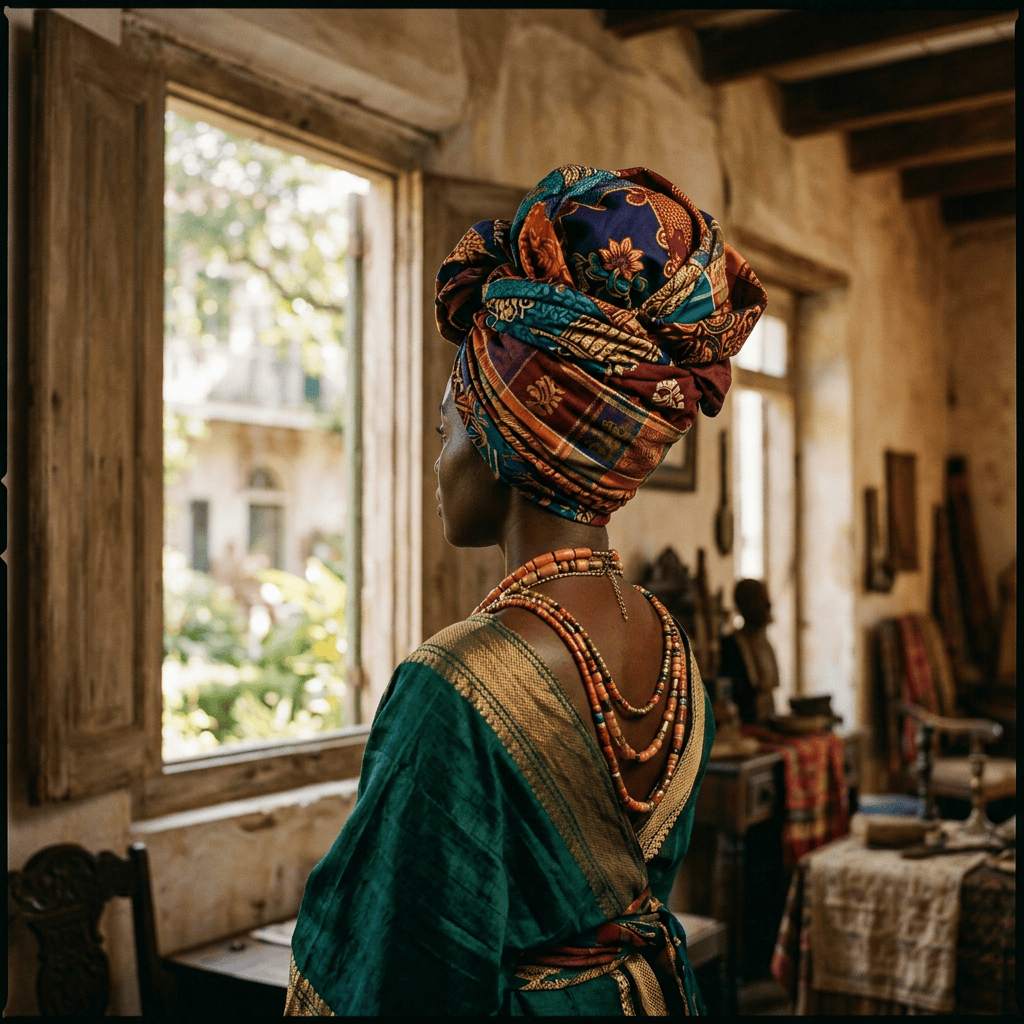
History is filled with attempts to diminish people’s identity, confidence, and sense of self, yet time and again, Afroglobal people have demonstrated an extraordinary ability to transform hardship into strength. Few examples illustrate this more powerfully than the story of the headwrap.
What was intended as a badge of inferiority became a signature of style. What was designed to hide Black beauty became a celebration of Black womanhood. Through creativity, resilience, and cultural pride, Afroglobal women transformed a symbol of oppression into one of dignity and elegance.
The Fear of Black Beauty
Across Africa, hairstyles were much more than fashion, hair often reflected a woman’s status, ethnicity, age, spirituality, and social standing. Elaborate braiding, adornments, and styling traditions were deeply woven into cultural identity. Enslaved Africans carried these traditions with them, even as slavery attempted to strip away every aspect of their humanity.
As African women arrived in the Americas and the Caribbean, many slaveholding societies viewed their natural beauty and cultural expressions as a threat to the established racial hierarchy. Black women often continued to care for and style their hair whenever circumstances allowed, maintaining a connection to their heritage despite unimaginable oppression.
In some regions, this attracted unwanted attention. Historical records suggest that the beauty and elegance of African women’s hairstyles and dress sometimes challenged the social order that enslavers sought to maintain. Rather than celebrating this beauty, authorities sought to conceal it.
The Tignon Laws
One of the most well-known examples occurred in Louisiana during the late eighteenth century. In 1786, Spanish colonial governor Esteban Rodríguez Miró introduced regulations commonly known as the Tignon Laws. These laws required women of African descent, particularly free Black women, to cover their hair in public.
The intention was clear, the law sought to mark Black women as socially inferior and prevent them from displaying hairstyles and adornments that some considered too elegant or attention-grabbing. The head covering was meant to identify them as belonging to a lower social class.
To the authorities, the headwrap was supposed to be a limitation.
To Afroglobal women, it became an opportunity.
Turning Restriction into Self-Expression
Rather than accepting the head covering as a mark of shame, Black women reimagined it.
They began using colourful fabrics, intricate folding techniques, decorative pins, jewellery, and creative styling methods to make their headwraps beautiful and distinctive. Instead of hiding their identity, they infused the wraps with personality, culture, and elegance.
What authorities intended as a symbol of subjugation became a canvas for artistic expression.
The transformation was profound. Women developed unique wrapping styles that showcased sophistication and confidence. The very item designed to diminish them became an extension of their beauty and individuality.
In a powerful act of silent resistance, they refused to allow others to define their worth.
A Legacy of Resilience
This story reflects a broader pattern throughout Afroglobal history. Whenever systems of oppression attempted to erase African identity, people found ways to preserve it for example, music became resistance, language became resistance, faith became resistance and fashion became resistance.
The headwrap joined that tradition.
Across Africa, the Caribbean, North America, South America, and Europe, headwraps evolved into important cultural symbols. Whether known as a gele, dhuku, doek, turban, or head tie, these coverings became expressions of heritage, faith, dignity, and style.
Today, headwraps appear on fashion runways, in places of worship, at weddings, cultural celebrations, and in everyday life. They are worn not because women are forced to wear them, but because they choose to embrace a tradition rich with meaning.
More Than Fashion
To view the headwrap simply as an accessory is to miss its deeper significance.
It represents survival.
It tells the story of women who faced laws and systems designed to suppress them, yet chose creativity over defeat. It speaks of generations who understood that true beauty cannot be legislated away and that cultural pride can flourish even under difficult circumstances.
The headwrap stands as a reminder that identity is not defined by those who seek to control it. It is defined by those who courageously preserve and celebrate it.
The story of Afroglobal women’s headwraps is a story of triumph. What began as an attempt to conceal Black beauty became a powerful statement of elegance, confidence, and cultural pride. Through resilience and imagination, Black women transformed a symbol of oppression into a global icon of style.
Their response carries a timeless lesson: when others attempt to define your worth, your greatest act of resistance is to celebrate who you are.
In every beautifully tied headwrap lies a story not of defeat, but of dignity, strength, and unapologetic pride.
By Fiona Lewis