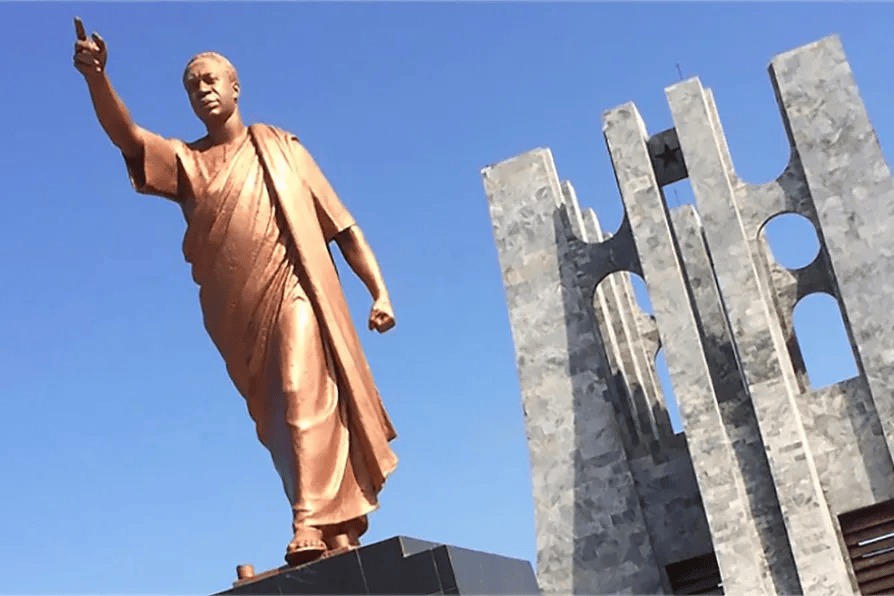
Inspired by my recent second visit to the Kwame Nkrumah Memorial Park and Mausoleum in Accra, Ghana.
There are certain places that do more than preserve history, they awaken something within you and my recent second visit to the Kwame Nkrumah Memorial Park and Mausoleum in Accra was one of those experiences. Walking through the grounds, observing the monuments, reading the accounts of a remarkable life, and standing before the resting place of one of Africa’s greatest visionaries, I found myself reflecting not only on the legacy of Kwame Nkrumah but also on the continuing relevance of his ideas in shaping the future of Africa and the global African family.
His story is not merely Ghana’s story, it is Africa’s story, it is the story of courage, sacrifice, possibility, disappointment, resilience, and an enduring belief that the destiny of African people is inseparable from unity, self-determination, and collective progress.
As I reflected on his life, I could not help but recognise how profoundly his vision resonates with the evolving Afroglobal philosophy that continues to inspire my own work and aspirations.
Humble Beginnings and an Extraordinary Journey
Kwame Nkrumah was born on 21 September 1909 in Nkroful, in what was then the Gold Coast, now Ghana. Raised in modest circumstances, he experienced firsthand the realities of colonial rule and the limitations imposed upon African people, yet from these humble beginnings emerged a young man driven by an insatiable desire for knowledge and transformation.
His educational journey took him from local mission schools to Achimota College and eventually to the United States, where he studied at Lincoln University and later the University of Pennsylvania. During these formative years, he encountered powerful ideas about freedom, social justice, self-governance, and the rights of oppressed peoples.
The experiences of African Americans, the anti-colonial struggles unfolding across the world, and the intellectual currents of Pan-African thought profoundly shaped his worldview and he began to see Africa not as a collection of separate colonies but as a continent whose people shared a common destiny and this belief would define the rest of his life.
Leading Ghana to Independence
If there is one achievement for which Nkrumah will always be remembered, it is his leadership in guiding the Gold Coast to independence.
On 6 March 1957, Ghana became the first sub-Saharan African colony to achieve independence from British rule and this moment represented far more than the birth of a new nation, it became a beacon of hope for colonised peoples throughout Africa.
Nkrumah understood the symbolism of the occasion when he famously declared:
“The independence of Ghana is meaningless unless it is linked up with the total liberation of Africa.”
This was not political rhetoric, it was a statement of purpose, as for Nkrumah, freedom could never be an individual achievement, genuine liberation required collective advancement and Ghana’s independence was only the beginning of a much larger mission.
The Architect of African Unity
Perhaps Nkrumah’s greatest legacy lies in his unwavering commitment to Pan-Africanism. Long before African unity became a fashionable concept, Nkrumah advocated for continental cooperation in politics, economics, education, defence, and development. He believed that fragmented African states would struggle to overcome the lingering effects of colonialism and external dependency and his efforts contributed significantly to the establishment of the Organisation of African Unity (OAU) in 1963, the precursor to today’s African Union. Although many of his contemporaries viewed his proposals as ambitious or even unrealistic, history continues to revisit many of the questions he raised:
How can African nations leverage their collective strength?
How can African economies retain more value from their resources?
How can Africans at home and abroad collaborate for shared prosperity?
How can cultural identity be preserved while participating confidently in a globalised world?
These questions remain as relevant today as they were during Nkrumah’s lifetime.
Building a Nation
Nkrumah was not simply a political theorist. He was also a nation-builder, and under his leadership, Ghana invested heavily in education, infrastructure, healthcare, and industrial development. New schools, roads, hospitals, and public institutions emerged as symbols of a nation determined to forge its own future. The Volta River Project and the construction of the Akosombo Dam remain among his most recognised development initiatives and these projects reflected his belief that African nations had the capacity to develop modern economies and world-class infrastructure.
His vision extended beyond immediate political gains as he wanted future generations to inherit a nation capable of standing confidently among the world’s developed countries.
The Struggles and Controversies
Great leaders are rarely free from criticism, and Nkrumah’s story is no exception, as the challenges of governing a newly independent nation intensified, economic pressures mounted and political opposition grew. Concerns emerged regarding centralised power, restrictions on political freedoms, and the increasingly authoritarian direction of his administration.
Nkrumah faced immense pressure from both internal and external forces during the Cold War era and his determination to pursue an independent path often placed him at odds with powerful interests.
In February 1966, while on a peace mission abroad, he was overthrown in a military coup, for many Africans, the event represented more than the removal of a president, it symbolised the fragility of newly won independence and the many obstacles confronting leaders who sought transformational change.
Exile and the Pain of Separation
The latter years of Nkrumah’s life were marked by exile, unable to return to the country he had helped create, he spent his remaining years largely in Guinea, where President Ahmed Sékou Touré welcomed him and honoured him as a co-president, yet beneath the honours and titles was a man separated from the nation he loved. There is something profoundly human about this chapter of Nkrumah’s life as it reminds us that leadership often comes with personal sacrifice and visionaries frequently experience rejection before history fully appreciates their contribution.
Despite exile, he never abandoned his commitment to African unity, he continued writing, advocating, and challenging future generations to pursue a united and empowered Africa.
Family and Personal Life
Behind the statesman was a husband and father. Nkrumah married Fathia Rizk, an Egyptian woman whose marriage to him symbolised the bridges he sought to build across Africa and their union represented both personal commitment and the broader ideal of continental interconnectedness.
Together they had children, and his family bore many of the burdens associated with public life as like many leaders whose lives become intertwined with national history, the personal and political often became impossible to separate. The story of his family serves as a reminder that the consequences of leadership extend beyond the individual to touch spouses, children, and generations that follow.
Death and Enduring Legacy
Kwame Nkrumah died on 27 April 1972 in Bucharest, Romania, after a period of ill health and although his political career ended under difficult circumstances, his influence did not. Over time, many aspects of his vision have been revisited and re-evaluated and today he is widely recognised as one of the founding figures of modern Africa and one of the most influential advocates of Pan-Africanism.
His image appears in books, speeches, institutions, and monuments throughout the continent, yet his greatest memorial is not the mausoleum in Accra, it is the persistence of the ideas he championed.
What Nkrumah’s Life Teaches Me
As I stood once again at the Kwame Nkrumah Centre with my elder sister, I realised that his greatest lesson is not simply about politics but rather about vision. Nkrumah teaches us that transformational ideas must often be pursued long before they become popular, he teaches us humility, that meaningful change requires courage to think beyond existing boundaries, that leadership is not measured solely by immediate success but by the ability to plant seeds that future generations continue to nurture.
Not every aspect of his vision was realised exactly as he imagined and not every decision he made produced the outcomes he desired, yet the willingness to dream beyond his circumstances remains deeply inspiring, and history rarely remembers those who simply accepted the world as it was, but rather remembers those who dared to imagine what it could become.
Nkrumah and the Evolving Afroglobal Vision
Reflecting on Nkrumah’s legacy has strengthened my conviction in the importance of the Afroglobal Vision. While rooted in an appreciation of African heritage, Afroglobal is not merely about looking backwards, its about creating meaningful connections between Africa and the wider global community in ways that are inclusive, innovative, collaborative, and future-focused. Nkrumah believed in unity that transcended artificial borders and troughout the broader Pan-African movement, numerous leaders and thinkers embraced the idea that African people, wherever they may be, share a responsibility towards collective advancement.
The Afroglobal Vision draws inspiration from this rich tradition while continuing to evolve in response to a rapidly changing world.
Today, our challenges and opportunities extend across education, technology, entrepreneurship, culture, health, environmental sustainability, digital innovation, and cross-cultural collaboration, making the conversation no longer solely about political independence, it is also about intellectual empowerment, economic participation, social inclusion, cultural confidence, and global interconnectedness.
The Afroglobal concept embraces Africa and its diaspora while welcoming partnerships, dialogue, and shared learning across communities, nations, and cultures. It seeks not simply to unite people through common origins but to connect them through common aspirations and in this sense, the vision remains expansive rather than exclusive, dynamic rather than fixed, and evolving rather than complete.
Carrying the Torch Forward
As I left the Kwame Nkrumah Centre after my second visit, I felt a renewed sense of purpose as the life of Kwame Nkrumah reminds me that every generation inherits unfinished work and the responsibility is not to replicate the past but to build upon its foundations. His generation fought for political liberation, our generation must pursue new forms of empowerment through education, innovation, enterprise, cultural understanding, and global connection highlothing that the challenges may have changed, but the need for vision remains. Nkrumah once looked beyond the constraints of his present reality and imagined possibilities many considered unattainable and today, as the Afroglobal concept continues to evolve as a conduit for connection, inclusion, learning, and progress, that same spirit of possibility continues to inspire the journey. Standing in the shadow of his legacy in Accra, I was reminded of a simple but powerful truth:
Great visions do not die with those who first imagine them, they live on in those who choose to carry them forward.
By Samantha Rockson