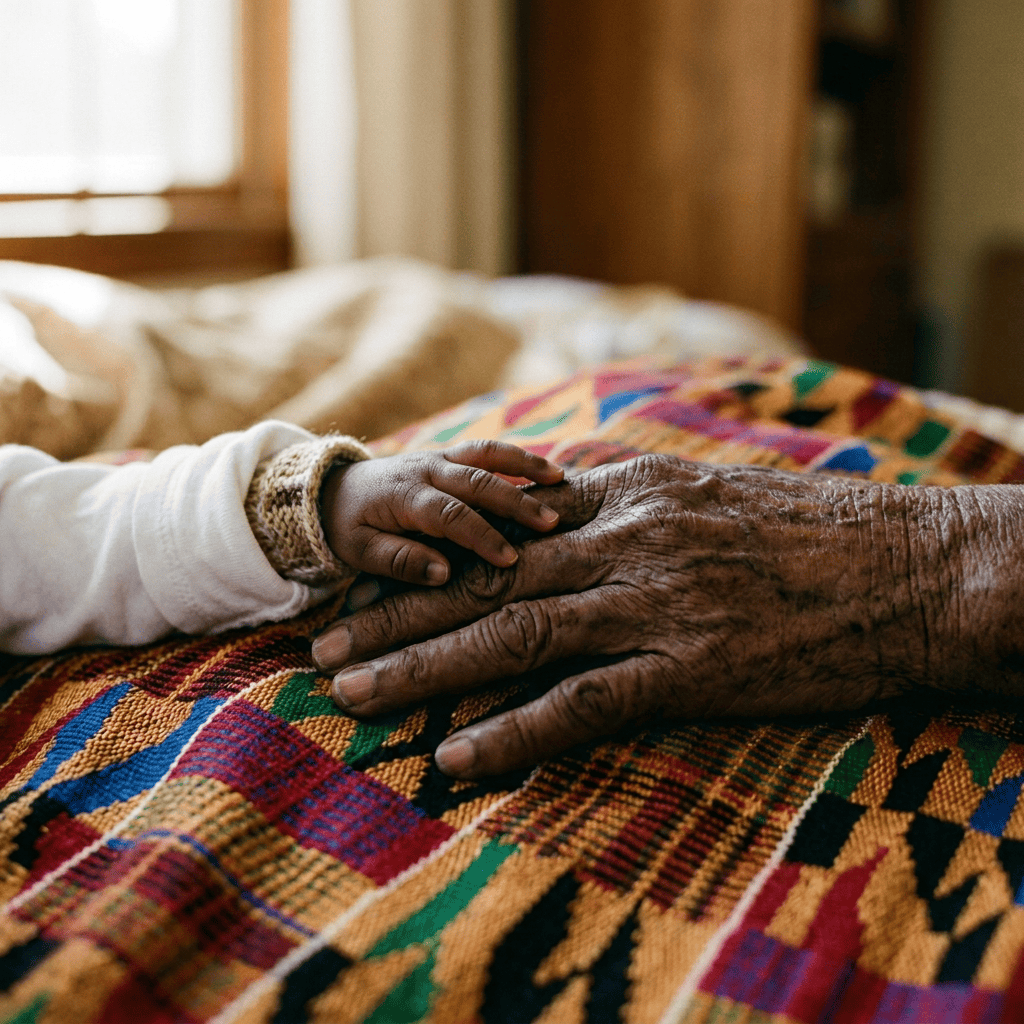
Perhaps one of life’s greatest lessons is hidden in this circle. Life ends where it begins.
Understanding this truth can help us live more meaningful lives, build stronger communities, and deepen our appreciation for one another, especially within the Afroglobal community, where respect for both the young and the elderly has long been embedded in cultural values.
The Circle of Life
A newborn enters the world unable to walk, feed themselves, communicate clearly, or survive independently. They rely on parents, relatives, and the wider community for care, guidance, and protection.
In later life, many elderly people find themselves needing similar support. Physical strength may decline, memory may weaken, and daily tasks that were once effortless may become challenging.
The strong become vulnerable.
The independent become dependent.
The teachers become the ones needing assistance.
It is a powerful reminder that human life is not a straight line of increasing strength and control, it is a circle that brings us back to where we started.
Similarities Between Babies and Older People
They Both Need Care
Babies cannot care for themselves, they depend entirely on others.
Many elderly people also require assistance with daily activities, healthcare, mobility, and companionship.
This similarity teaches us humility as no matter how successful, wealthy, educated, or powerful we become, there may come a time when we need others just as much as we once did at the beginning of life.
They Both Seek Comfort and Security
A baby feels safe in familiar arms.
An older person often finds comfort in familiar faces, routines, memories, and relationships.
Both remind us that beneath all our achievements, human beings simply long to feel loved, accepted, and secure.
They Both Value Presence More Than Possessions
A baby does not care about status symbols, luxury brands, or bank balances.
Similarly, many older people nearing the end of life rarely speak about possessions, instead, they cherish family gatherings, friendships, shared memories, and meaningful conversations.
The youngest and oldest among us often understand a truth that those in the middle of life sometimes forget:
People matter more than things.
They Both Teach Us Patience
Babies teach patience through their constant needs and demands.
Older people teach patience through slower movement, repeated stories, and changing abilities.
In both cases, patience becomes a form of love.
When we learn to slow down and care for others, we become better human beings.
The Illusion of Endless Time
Many people spend their younger years believing life is long and opportunities are endless.
We postpone dreams.
We delay forgiveness.
We neglect relationships.
We assume there will always be another chance.
Yet the elderly often remind us that time passes faster than we imagine.
A baby is born today.
Before long, that baby is graduating from school.
Soon after, building a career.
Then raising children.
Then watching grandchildren grow.
The years that seem distant arrive much sooner than expected, and life’s cycle teaches us not to waste the present moment.
Wisdom from the Elders
Across Africa and afroglobal communities, elders have traditionally been viewed as living libraries.
They carry stories, lessons, experiences, and cultural knowledge collected over decades.
Yet modern society often celebrates youth while overlooking the wisdom of age.
This is unfortunate because older people have already travelled roads the younger generation is just beginning to walk.
They understand the consequences of choices.
They know the value of resilience.
They have experienced both triumph and disappointment.
They recognise that character matters more than appearance and purpose matters more than popularity.
Their experiences can help younger generations avoid unnecessary mistakes and make wiser decisions.
What Babies Teach Us
While elders teach wisdom, babies teach something equally important.
They teach curiosity.
They teach wonder.
They teach authenticity.
A baby laughs freely.
Cries openly.
Explores fearlessly.
Lives entirely in the present moment.
As adults, many of us lose these qualities, we become overly concerned about people’s opinions, fearful of failure, and burdened by endless worries about the future.
Perhaps part of living well is learning to rediscover the child within us.
Lessons for the Afroglobal Community
The Afroglobal community has a rich tradition of valuing both generations.
There is an African proverb that says:
“When an old person dies, a library burns to the ground.”
The proverb reminds us that every elder carries invaluable knowledge that should be passed on before it is lost, at the same time, every child represents possibility, hope, innovation, and the future.
Strong communities are built when these two generations remain connected.
When grandparents tell stories.
When children listen.
When elders mentor.
When young people respect experience while contributing fresh ideas.
When wisdom and innovation walk hand in hand.
Unfortunately, migration, busy lifestyles, and modern distractions can sometimes create distance between generations within Afroglobal families and communities.
Rebuilding these connections may be one of the most important investments we can make.
Living Better Through the Wisdom of the Circle
If life truly ends where it begins, then several important lessons emerge:
Love people while you can.
The relationships we nurture today become the memories we treasure tomorrow.
Practise humility.
The help you provide today may be the help you need tomorrow.
Respect every stage of life.
Children and elders both possess unique wisdom and value.
Focus on what truly matters.
Titles, possessions, and status eventually fade, character, relationships, and legacy endure.
Build bridges between generations.
Communities flourish when knowledge flows from the old to the young and energy flows from the young to the old.
Life’s greatest wisdom may be hidden in its circular nature. We enter the world needing care, and many of us leave it needing care once again. Between these two moments lies an opportunity to love, learn, serve, and grow.
Babies remind us how to embrace wonder.
Elders remind us how to embrace wisdom.
Together, they reveal what truly matters.
Recognising this truth can strengthen families, preserve cultural heritage, and create deeper bonds between generations.
Life ends where it begins, but the measure of a life is not found in the beginning or the end, it is found in how we treat others during the journey.
And perhaps the wisest life of all is one that combines the curiosity of a child with the wisdom of an elder.
By Samantha Rockson