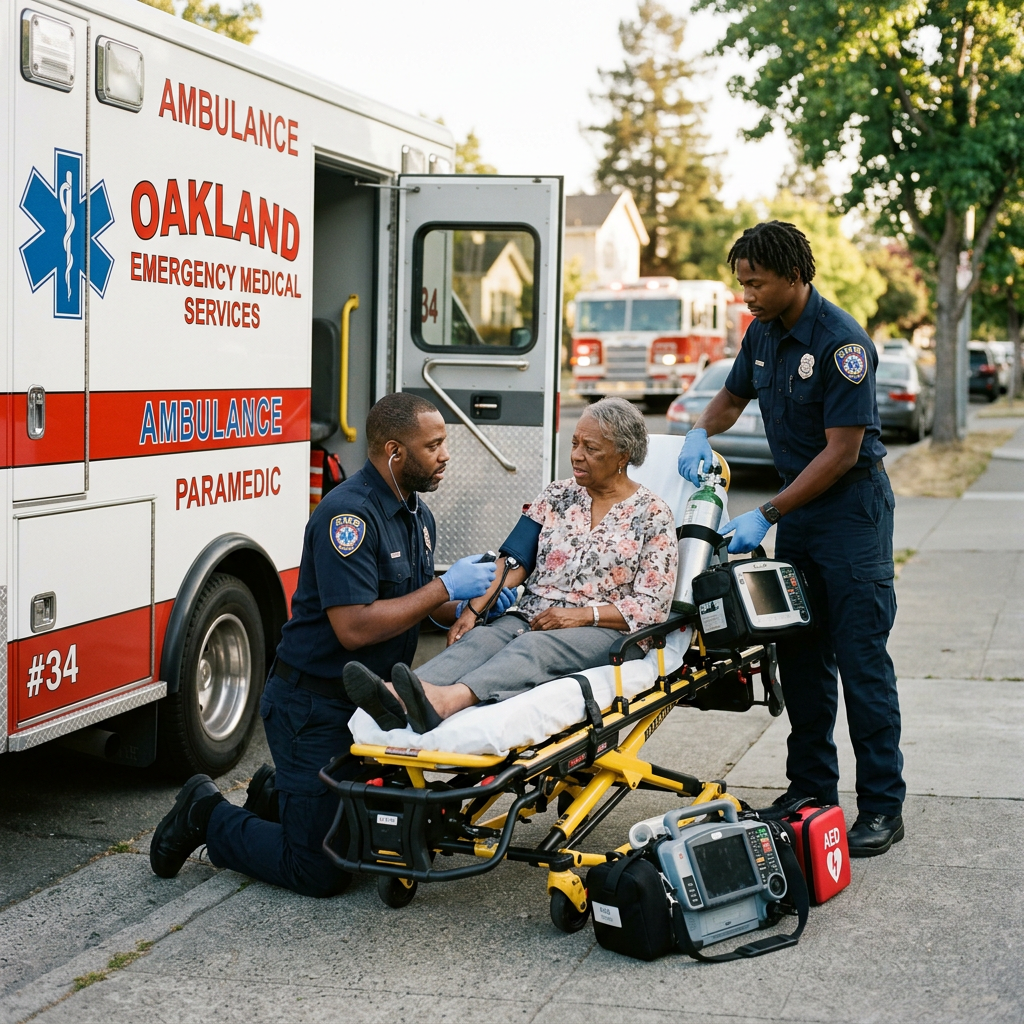
The modern paramedic system, the protocols, training standards, and emergency response model used worldwide was pioneered in the 1960s by Black men from Pittsburgh’s Hill District, whose groundbreaking work has been largely erased from mainstream narratives. Their innovations solved a public‑health crisis, reshaped emergency medicine, and hold deep significance for the Afroglobal community today.
Origins: A Crisis That Exposed a System’s Failure
By the early 1960s, American emergency response was shockingly primitive.
Police wagons or hearses transported patients. Officers had no medical training, and survival rates for trauma victims, especially in Black neighbourhoods were devastatingly low.
A 1966 report titled Accidental Death and Disability: The Neglected Disease of Modern Society called the situation a national disgrace. But while policymakers debated, Black communities lived the consequences daily.
This is where the story of Freedom House Ambulance begins.
The Birth of a Revolutionary Idea
In 1967, community leader Phil Hallen, medical visionary Dr. Peter Safar, and local organizer Nancy Carolinepartnered with unemployed Black men from Pittsburgh’s Hill District to create something unprecedented:
A fully trained, medically skilled emergency response team, the world’s first paramedics.
These men were recruited not because they had medical backgrounds, but because they had potential, discipline, and a desire to uplift their community.
Their training included:
- Advanced CPR
- Airway management
- IV therapy
- Cardiac care
- Trauma stabilization
- Field diagnostics
This level of training was unheard of at the time. Even doctors doubted whether non‑physicians could learn such skills. The Freedom House recruits proved them wrong.
What Problem Were They Trying to Solve?
The founders and trainees were addressing three interconnected crises:
- Medical inequality — Black neighbourhoods had the worst emergency outcomes in the country.
- Unemployment — systemic barriers kept Black men out of stable, respected professions.
- Public safety — police‑run ambulance services were untrained and often harmful.
Freedom House solved all three by creating a professional medical corps rooted in the community itself.
How the System Evolved Into Modern EMS
The success of Freedom House was undeniable. Their response times, survival rates, and medical outcomes outperformed police ambulances. Doctors began requesting Freedom House crews specifically.
Their innovations became the blueprint for:
- National paramedic training standards
- Ambulance design and equipment
- On‑scene medical protocols
- CPR and resuscitation procedures
- Trauma triage systems
By the mid‑1970s, cities across the U.S. and eventually the world, adopted the Freedom House model.
Why We Aren’t Told This in the Mainstream
There are several reasons this history was buried:
1. Racial Politics
Freedom House’s success challenged stereotypes about Black competence in medicine and public safety. When Pittsburgh’s mayor replaced them with an all‑white EMS force, the narrative shifted to erase their contributions.
2. Institutional Ownership
Hospitals and governments preferred to present EMS as a top‑down innovation, not a community‑driven Black achievement.
3. Media Erasure
Mainstream media of the era rarely credited Black innovators unless forced to. Freedom House was no exception.
4. Professional Gatekeeping
As EMS became a respected medical field, institutions rewrote its origin story to center physicians and policymakers not the Black men who proved the model worked.
Significance for the Afroglobal Community
The legacy of Freedom House, and the Black men who built the paramedic system, carries profound meaning today.
Proof of Black Medical Innovation
This history demonstrates that Black communities have shaped global medical standards, even when denied recognition.
A Model of Community‑Driven Solutions
Freedom House shows how local leadership can solve systemic problems faster than institutions.
A Blueprint for Modern Health Equity
Their work is a reminder that healthcare justice often begins with marginalized communities innovating for themselves.
A Call to Reclaim the Narrative
Understanding this history empowers the Afroglobal community to:
- Preserve Black medical history
- Advocate for representation in healthcare
- Build new community‑based health systems
The modern paramedic system, the one that saves millions of lives every year, was not born in a boardroom or a government office.
It was built in a Black neighbourhood, by Black men, trained to a level the world had never seen before.
Their story is not just history.
It is a reminder of what the Afroglobal community has always been capable of: innovation, resilience, and world‑changing brilliance.
By Michael Frazer