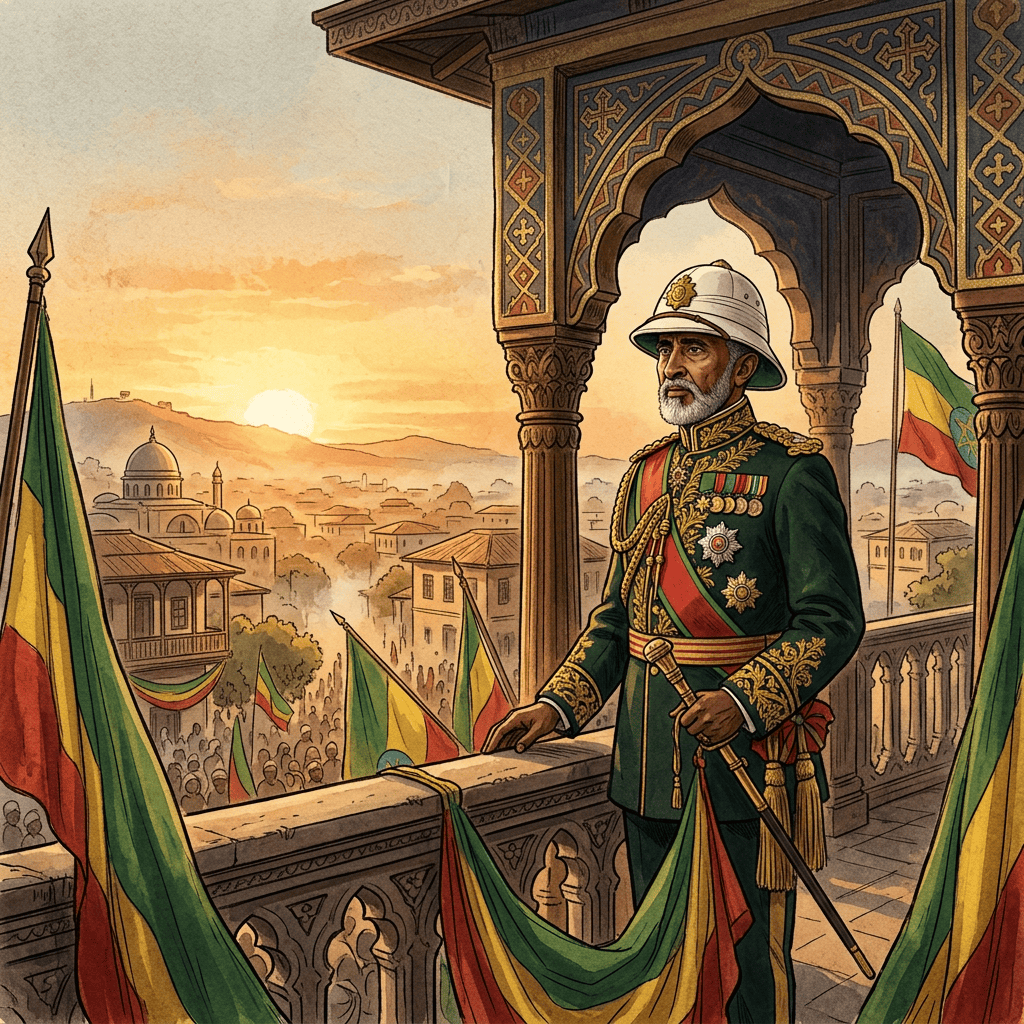
Few African leaders have inspired as much admiration, debate, and spiritual devotion as Haile Selassie I, the last Emperor of Ethiopia. To some, he was a champion of African independence and unity to others, he was an autocratic ruler whose reign ended amid famine and political unrest. His life spanned some of the most dramatic events of the twentieth century, from colonial aggression and world war to the rise of Pan-Africanism and the birth of the Rastafarian movement.
Early Life and Parentage
Haile Selassie was born Tafari Makonnen on 23 July 1892 in Ejersa Goro, Harar Province, Ethiopia. His father was Ras Makonnen Wolde Mikael, a prominent nobleman, military commander, and governor of Harar. His mother was Woizero Yeshimebet Ali.
Through his father’s lineage, Tafari belonged to Ethiopia’s ancient Solomonic Dynasty, which claimed descent from King Solomon and the Queen of Sheba.
Ethiopia and the Struggle Against Colonisation
Ethiopia occupies a unique place in African history. During the nineteenth-century “Scramble for Africa”, nearly the entire continent fell under European colonial rule, Ethiopia, however, successfully resisted colonisation.
The most significant victory came in 1896 at the Battle of Adwa, when Ethiopian forces defeated the invading Italian army. This victory made Ethiopia one of the few African nations to preserve its sovereignty during the colonial era and became a symbol of African resistance to European domination. For people of African descent around the world, Ethiopia became a symbol of Black pride, independence, and resilience.
Coronation as Emperor
Following the death of Empress Zewditu, Ras Tafari was crowned Emperor of Ethiopia on 2 November 1930 at St George’s Cathedral in Addis Ababa. He took the throne name Haile Selassie I, meaning “Power of the Trinity.”
His grand titles included:
“King of Kings, Lord of Lords, Conquering Lion of the Tribe of Judah, Elect of God.”
The splendour of his coronation attracted worldwide attention and would profoundly influence a growing spiritual movement thousands of miles away in Jamaica.
Marcus Garvey’s Prophecy
Jamaican Pan-African leader Marcus Garvey is often associated with the statement:
“Look to Africa, when a Black King shall be crowned, for the day of deliverance is near.”
Although historians debate the exact wording and whether Garvey ever spoke these precise words, many followers believed Haile Selassie’s coronation fulfilled this prophecy. The event inspired the emergence of the Rastafari movement in Jamaica during the 1930s.
How Rastafarians Viewed Haile Selassie
To Rastafarians, Haile Selassie was not merely an emperor. Many regarded him as the living God, the returned Messiah, and the earthly manifestation of Jah (God).
The movement took its name from his pre-coronation title, Ras Tafari.
However, Haile Selassie himself never claimed to be divine. Throughout his life, he remained a committed member of the Ethiopian Orthodox Church. When asked about Rastafarians who worshipped him as God, he reportedly rejected such claims and pointed worshippers towards Christ rather than himself.
The Italian Invasion of Ethiopia
In October 1935, Fascist Italy, under Benito Mussolini, invaded Ethiopia, seeking revenge for Italy’s defeat at Adwa and hoping to build a colonial empire in Africa.
Although Ethiopian soldiers fought bravely, they faced a modern military equipped with tanks, artillery, and aircraft.
The war became infamous because Italian forces used chemical weapons, including mustard gas, against Ethiopian troops and civilians. Italian aircraft dropped bombs and poisonous gas on soldiers, villages, livestock, rivers, and farmland. Haile Selassie later described how aircraft first used tear gas before resorting to mustard gas.
Witnessing these attacks convinced the Emperor that the world was facing a dangerous new form of warfare that threatened all nations.
“It Is Us Today, It Will Be You Tomorrow.”
After Ethiopia fell, Haile Selassie went into exile and travelled to Geneva to address the League of Nations on 30 June 1936. There he delivered one of the most famous speeches in modern history.
Warning the world about fascist aggression and chemical warfare, he declared:
“It is us today. It will be you tomorrow.”
His warning proved prophetic. Within a few years, Europe itself was engulfed in the Second World War.
Exile in England
After leaving Ethiopia, Haile Selassie lived in Bath, England, from 1936 until 1941. During his years in exile he campaigned tirelessly for international support against the Italian occupation of Ethiopia.
When British and Ethiopian forces drove the Italians out during the Second World War, Haile Selassie triumphantly returned to Addis Ababa in 1941.
Champion of African Unity
Perhaps Haile Selassie’s greatest international achievement came in 1963, when he hosted African leaders in Addis Ababa for the creation of the Organisation of African Unity (OAU).
The organisation sought to:
Promote African solidarity
Support liberation movements
Defend African sovereignty
Encourage economic cooperation
Many newly independent nations joined the OAU, including:
Ethiopia
Ghana
Nigeria
Kenya
Tanzania
Algeria
Senegal
Uganda
Zambia and many others across the continent. The OAU later evolved into today’s African Union (AU).
The Speech That Became a Bob Marley Song
One of Haile Selassie’s most influential addresses was a speech delivered to the United Nations in 1963, in it he declared that lasting peace could not exist while racism and inequality persisted.
Years later, Bob Marley adapted sections of this speech into the famous song “War.”
The song’s most memorable lines echo Selassie’s message that peace would remain a distant dream until the philosophy which holds one race superior and another inferior was abandoned.
The Visit to Jamaica in 1966
On 21 April 1966, Haile Selassie visited Jamaica. Thousands of Rastafarians gathered at Kingston airport to welcome him. The occasion became a defining event in Rastafarian history as for believers, the Emperor’s arrival on Jamaican soil was a spiritual fulfilment. The date remains celebrated by many Rastafarians as Grounation Day.
Famine and Criticism
Despite achievements in diplomacy and international affairs, Haile Selassie’s reign faced increasing criticism at home. During the early 1970s, severe famine struck parts of Ethiopia, particularly Wollo Province. Critics accused the government of concealing the scale of the disaster and responding too slowly. Television reports exposing the suffering shocked Ethiopians and damaged the Emperor’s reputation as many began to question whether the monarchy was capable of addressing the country’s growing social and economic problems.
Deposition and House Arrest
In 1974, military officers known as the Derg overthrew Haile Selassie after nearly forty-four years as Emperor. The ageing monarch was removed from power and placed under house arrest in Addis Ababa. His deposition marked the end of Ethiopia’s ancient monarchy and the beginning of a military socialist government.
Death and Legacy
Haile Selassie died on 27 August 1975 while under detention. Official accounts initially suggested natural causes, but later investigations concluded that he had probably been murdered by strangulation. His remains were eventually reinterred with state honours at Holy Trinity Cathedral in Addis Ababa.
Haile Selassie remains one of the most important and complex figures in African history. He stood against fascist aggression, warned the world about the dangers of dictatorship, championed African unity, and inspired a global religious movement, at the same time, his reign was marked by inequality, famine, and political unrest that ultimately led to his downfall.
To some, he is remembered as a visionary Pan-African statesman, to others, he is a ruler who failed to modernise his nation quickly enough and yet regardless of one’s view, his influence on Ethiopia, Africa, and the Afroglobal remains profound and enduring.
By Emma Harding