
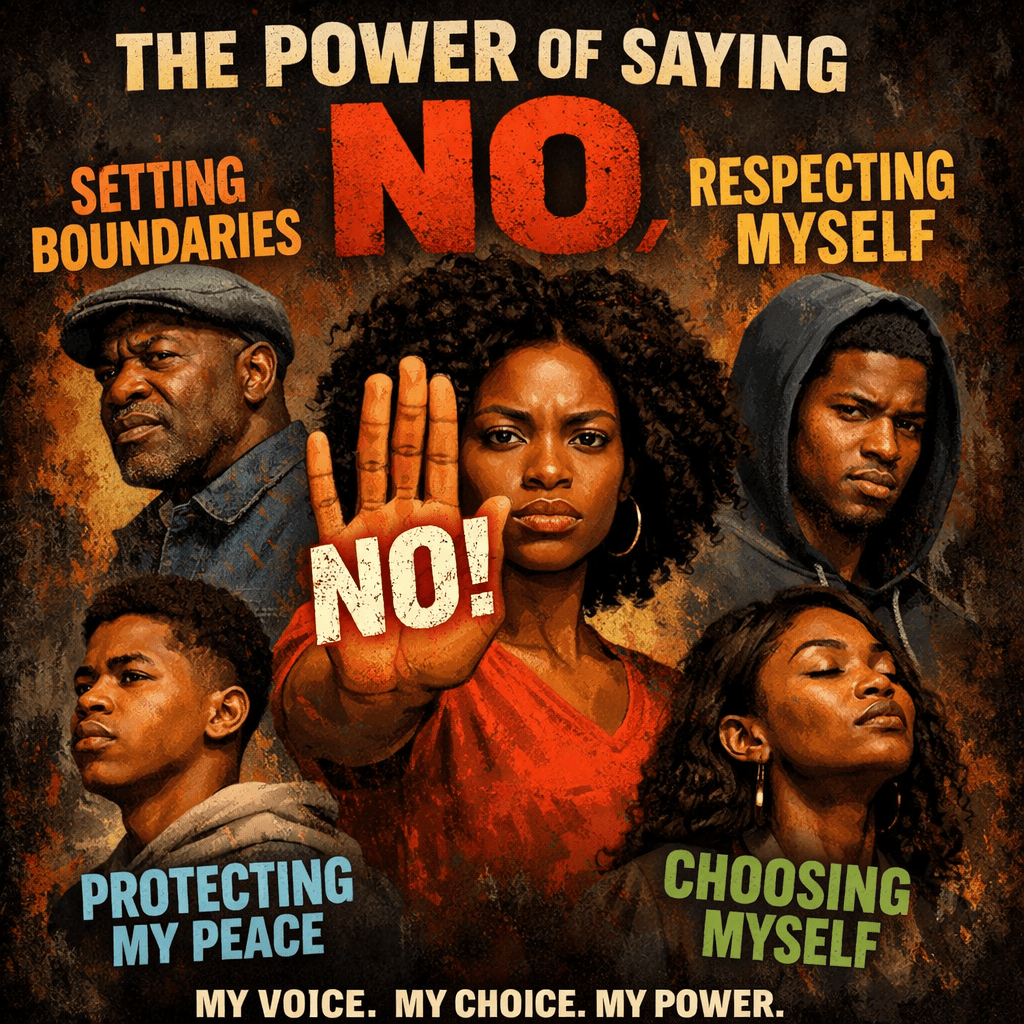
Saying no is one of the simplest acts of self‑preservation, yet one of the hardest skills to master. It is a boundary, a declaration of self-worth, and a refusal to be stretched beyond one’s emotional, financial, or spiritual capacity. But in many Black communities, across the diaspora, this principle has been quietly neglected, often unintentionally, often at great cost.
This isn’t about blaming individuals. It’s about understanding the historical, cultural, and social forces that have shaped a pattern of over-giving, over-extending, and over-performing niceness, even when it harms us.
Why “No” Is a Revolutionary Word
At its core, “no” is a form of power. It protects:
- Time
- Energy
- Mental health
- Finances
- Identity
Saying no allows a person to prioritize their own needs without guilt. It is a boundary that says: I matter too.
But for many Black people, especially in Western societies, the ability to say no has been historically discouraged. Survival often depended on compliance, politeness, and emotional labor. Generations learned to be agreeable because being “too assertive” could be punished socially, economically, or even violently.
That legacy doesn’t disappear overnight.
The Pressure to Be “Nice” All the Time
In many Afroglobal communities, there is a strong cultural emphasis on:
- Being helpful
- Being available
- Being self-sacrificing
- Being “strong”
- Being agreeable to avoid conflict
These traits come from a place of love and resilience. They helped families survive hardship, discrimination, and instability. But they also created a silent expectation: your needs come last.
This can show up in many ways:
- Feeling obligated to financially support relatives even when struggling
- Saying yes to emotional labor you don’t have capacity for
- Avoiding boundaries to avoid being labeled “selfish”
- Overworking to prove worth in professional spaces
- Being afraid to disappoint others
- Feeling responsible for everyone’s comfort
Niceness becomes a shield, but also a burden.
How This Neglect Shows Up Today
1. Burnout disguised as strength
Many Black individuals are praised for being “strong,” but that strength often hides exhaustion. When saying no is seen as weakness, people push themselves until they break.
2. People-pleasing as survival
Generations learned to avoid conflict with authority, institutions, or even within families. That survival strategy can turn into chronic people-pleasing.
3. Guilt around self-prioritization
Choosing yourself can feel like betraying your community. But self-neglect is not loyalty.
4. Emotional labor without reciprocity
Black women especially are often expected to be caretakers, mediators, and emotional anchors for everyone else.
5. Difficulty setting boundaries in relationships
When boundaries are not modeled, they become difficult to enforce. Many grow up believing that love equals sacrifice, even when it hurts.
Why This Pattern Must Change
Saying no is not disrespect. It is not abandonment. It is not selfishness.
It is self-respect.
Communities grow stronger when individuals are healthy, rested, and empowered. Boundaries create:
- Healthier families
- Healthier relationships
- Healthier mental states
- Healthier futures
A community cannot thrive if its members are drained.
Reclaiming the Power of “No”
Here are steps toward shifting the culture:
1. Normalize rest
Rest is not laziness. It is recovery.
2. Teach children boundaries early
A child who can say no becomes an adult who can protect themselves.
3. Stop glorifying self-sacrifice
Helping others is beautiful, but not when it destroys you.
4. Challenge the fear of disappointing people
Disappointment is temporary. Self-betrayal lasts longer.
5. Redefine strength
Strength is not suffering in silence. Strength is choosing yourself without apology.
A New Cultural Standard
Imagine an AfroGlobal community where:
- Saying no is respected
- Boundaries are normal
- Rest is valued
- Emotional labor is shared
- Self-care is not a luxury
- Niceness is a choice, not a survival tactic
That is a community that thrives, not just survives.
Saying no is not about rejecting others. It is about accepting yourself. It is about reclaiming time, energy, and dignity. It is about breaking generational patterns that taught us to shrink ourselves for the comfort of others.
The truth is simple:
You do not have to be nice all the time. You do not have to say yes to everything. You are allowed to protect your peace.
And that shift, quiet, powerful and unapologetic, can transform not just individuals, but entire communities
By Tracey Rosmond



 Your Magazine
Leave a comment